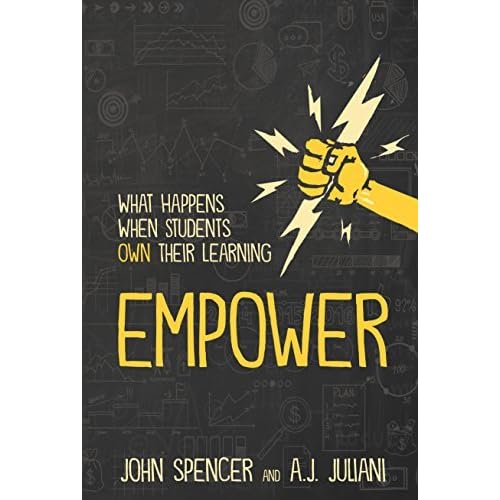
Empower is honestly a book I should read every month to remind and reaffirm to me that what I do in my classroom is right for students. AJ and John introduce the book as for "the wild ones" and "the innovators and teachers who are rewriting the rules." THIS BOOK IS FOR ME! There is so much I take away from this book, so without further ado, away we go . . .
For 19 years I was that teacher. The teacher whose students were being talked at and taking notes. I would do so much work to find demonstrations to make the concepts come alive. I spent countless hours writing and rewriting prescribed labs only to get back the same thing from every student. The only thing I knew was "the old formula" for my students - to be compliant. 5 years ago I shifted to the flipped classroom and have seen increased engagement and empowerment in my students each year.
AJ & John define the empowered classroom as one that is (and I paraphrase here) committed to student interests, to prepare them for anything, to ask them "What do you want to learn?", to have students create their own path, having students assess their own learning, and to promote creativity.
In Chapter 3 they promote the shift from "making the subject interesting" to tapping into student interests. As a physics teacher, I always prided myself on finding real-world examples to make the concepts relatable to my students. I performed cool demonstrations (the disappearing eye dropper!), found interesting videos (Bill Nye anyone?), and created exciting activities (pushing my car to study Newton's 2nd Law!) to "wow" my students. There was one thing I didn't realize then - these things were all cool and exciting to me, but were they cool and exciting to my students? I was doing so much more work than my students were. In a traditional classroom, it is easy to sit there and "do school" - take notes, fill out the worksheet, complete the lab report, take the test, REPEAT. However, empowering students takes more work on their part than a traditional classroom as students now take ownership of their learning. Empower pushes me to ask my students what their interests are and how they can relate the concepts to these interests.
Student choice is the basis for Chapter 4 and has challenged me to rewrite my unit on Waves and Light next term. I give students choice in my classroom from Genius Hour to their products that showcase their learning. However, I have not gone full PBL and empowered my students. I am currently planning for students to choose how they access the content for Waves and Light (characteristics, behaviors, the EM Spectrum, image formation by mirrors and lenses), then asking them to demonstrate their knowledge by making a video (or digital book or podcast) their classmates can also access to learn the concepts. By doing this I hope to achieve AJ & John's goal of - "Changing the game of school means actually allowing students to create their own game. This is empowerment." This empowerment really starts with a single question as posed in Chapter 5, "What decisions am I making for my students that they could make for themselves?" As each year of flipped learning has gone by, I have given up more and more control to the students. "It's a shift from a compliant mindset to a self-directed mindset" as AJ & John stated in Chapter 6. This shift is not only for teachers but for students as well.
In Fall 2016, I introduced an Innovations Class to my high school. I had been inspired by Don Wettrick and his students at Noblesville HS and wanted to offer this opportunity to my community of learners. This type of class is one that demands students to be self-starters and self-managers (Chapter 6). Students begin by choosing topics, writing pre-mortems, and proceed to chart their course. They further set 2-week plans, choose strategies to achieve their goals, and provide evidence of answers to their questions. During this process, there is much 1:1 peer assessing (via Walk and Talks) and self-assessing of their progress. Some are conducting interviews, creating and analyzing surveys, reading articles, watching videos, and cold emailing professionals in the field. Yes, and all this is going in one classroom! It may appear chaotic from the outside, but I appreciate how each student is choosing to create his/her "authentic research experience." (Chapter 7)
Now how does a teacher go about assessing these new experiences? In Chapter 8 AJ & John challenge teachers to make assessment more like life and less like school. "The shift from taking an assessment to assessing their own learning." My classroom has become full of micro-conversations with individual students, thus giving consistent feedback throughout the learning process. But how I can I empower students to own the assessment process? They suggest students be able to figure out:
- what they already know
- what they don't know
- what they want to master
- what they will do to improve
"Through self-assessment students attribute success to themselves, not the teacher and feel empowered." I look to use more of what they recommend to challenge my students to:
- chart progress
- track goals
- self-reflect
- survey their learning
- self-assess with rubrics
- use checklists
These are many ideas to consider when designing assessments to include students in the process.
In Chapter 10 AJ & John talk about ice cream. Ice cream? They lay out the argument of differentiation in a tiered system compared to an adjustable system. Their example is as follows: at Baskin Robbins you can choose your flavor and choose 1 scoop, 2 scoops, etc. However, at your local frozen yogurt place, you can choose exactly the amount of fro-yo and the type and amount of toppings as well. From the tiered system of BR31 where the teacher provides the options to the adjustable system of fro-yo where students "own the entire process." Now before you open up your fro-yo classroom, think about this - what about a Coldstone Creamery classroom? That is one where "students move from choice to freedom in the content." They take it one step further and ask, "What if students felt the permission to modify things on their own? #mindblown For a student to modify on their own s/he would have to be in tune with their learning style. I have sat in many IEP meetings where parents and teachers discuss the accommodations in the plan. But instead of parents and teachers being responsible for these, what if the student took real ownership of their learning and designed their own strategies to best assess their learning? There is much to consider here and would be a shift in thinking how to execute an education plan. With classes of students with a multitude of learning styles, this appears messy and chaotic, but as AJ & John state, "but it doesn't matter, its frozen yogurt, every work is supposed to be different."
When I reflect on my first 19 years of teaching, I thoroughly enjoyed being up there in front of the students. Every lecture was a performance. I loved making bad physics jokes and being the one person in the room who had all the attention. How could I flip my class and put my students in charge of their learning and be relegated to "guide on the side"? What would happen to me? AJ & John respond, "So does being a "guide on the side" mean you lose your influence? No. Guides are actually pretty influential (take Gandolf, Yoda, Ms. Frizzle)." In my flipped classroom I feel even more important now that I have the time to talk to every student every day and be their guide.
Thank you AJ and John for reaffirming for my shift in teaching 5 years ago, the inspiration to keep going, and the new challenges you pose in Empower.

No comments:
Post a Comment