As I am currently teaching one section of Honors Physics, this gives me the best opportunity to pilot PBL. We just returned back from a week of April vacation and finished up a unit on Electricity & Magnetism, so the students are refreshed and ready for a new challenge. The PBL will be for the unit on Waves. I feel this is a perfect fit for PBL as there are many examples of waves (water, sound, light, seismic, etc.) and students can choose which waves they want to apply the standards to and create a project.
Maker Challenge
Before I challenge my students to design a project on his/her own, I provided them with an experience in divergent thinking. I used the lesson from John Spencer that he provides for FREE as download from his PBL Toolbox. Here is his maker challenge:
I gathered supplies at the ready for my students including scissors and masking tape to aid in the construction.
Once my 20 students arrived, I introduced them to the challenge and gave them 5 minutes to brainstorm what they each would make with the given materials. They proceeded to share their ideas round-robin style with classmates at their table (4 students total).
 |
| Students sharing their ideas in their groups of 4 at their table. |
Next, I formed teams of 2 students (random name drawings chosen from a coffee can). Once in their team they shared ideas and crossed out ones that didn't make sense, combined similar ideas, and even tried to "mash-up" seemingly unrelated ideas. I then asked them to choose 1 idea to construct a prototype of in the next 40 minutes.
 |
| Students in teams of 2 sharing their ideas and deleting, combining, & mashing-up! |
As I walked around the room, I asked students what they were making and was sure to ask them what problem their idea would solve and who the prospective user would be. With this being my first time doing a maker challenge, I was impressed at their enthusiasm and the uniqueness of each group's ideas.
 |
Students constructing a roller coaster ramp. FYI it never fully worked during their tests, but it did work when they presented to their classmates! #superexciting |
 |
| Team modeling their latest snorkel-goggle prototype! |
After the 40 minutes of construction, students proceeded to share their prototypes with their classmates. Here is what the 10 teams produced: bird feeder, play mobile for crib, floating Ferris wheel toy for the bath, roller coaster ramp, mini-guitar picture frame, slingshot, snorkel-goggles, portable flute, bluetooth controlled portable fan, and fishing pole with floating tackle box. Yes, all those different ideas from using the same materials!
Student Reflection
The last part of the challenge was for each student to reflect on their experience. I asked them to respond to 3 questions on our LMS:
- What was your product? What problem does it solve and who is the ideal consumer?
- Describe 2 problems or failures that happened along the way to creating the final product. How were they overcome and/or what was the importance of them?
- What is 1 takeaway from your experience in the Maker Challenge?
Here are some of their responses:
Problems/Failures:
" It was much more harder to make than I thought it would be, and I realized that when looking at the materials. We also had to play around with the design and what we wanted it to look like. It took a couple of eliminations and additions of materials to be satisfied with the final product."
" It was much more harder to make than I thought it would be, and I realized that when looking at the materials. We also had to play around with the design and what we wanted it to look like. It took a couple of eliminations and additions of materials to be satisfied with the final product."
Takeaways:
"It was a good was to practice being creative and to really think outside the box. I also found brainstorming independently and then combining ideas with other people to be extremely helpful and productive."
"One thing that I learned from this activity was that when designing a product or simply completing a task, it's not always going to go as planned so in order to be successful you are going to need to be innovative in the sense that you need to be creative with how you find a solution to any obstacles you may stumble upon."
"I've realized how difficult it is to design and create new products and prototypes without ample time and research. It makes me wonder how people keep inventing new and original technologies."
"One thing that I learned from this activity was that when designing a product or simply completing a task, it's not always going to go as planned so in order to be successful you are going to need to be innovative in the sense that you need to be creative with how you find a solution to any obstacles you may stumble upon."
"I've realized how difficult it is to design and create new products and prototypes without ample time and research. It makes me wonder how people keep inventing new and original technologies."
From Divergent Thinking to Design Thinking for PBL
I began by providing my students with a challenge (set of materials), they brainstormed many ideas for what they could make out of them. Thus, there was no wrong answer and the only constraint was the materials list.
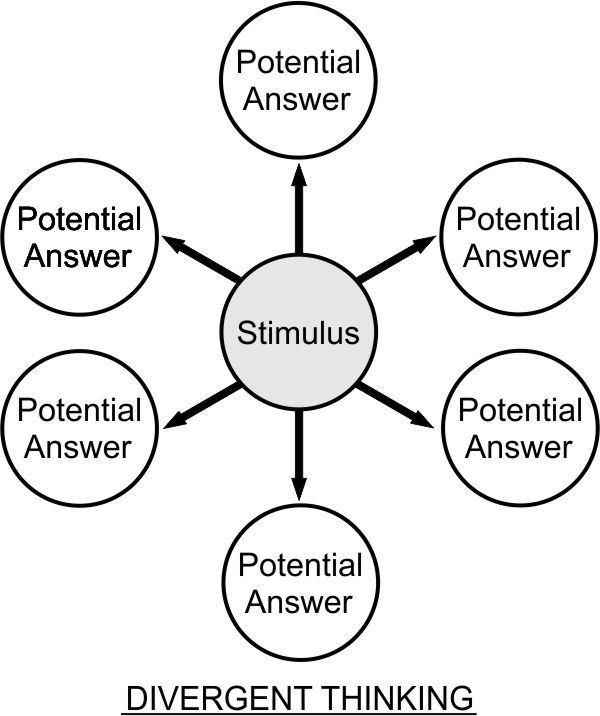
After the students created a list of possibilities, they used convergent thinking with a partner to narrow their lists down to 1 idea to construct. As my students move on through PBL, I will promote a more design thinking approach to their project. The concepts of the project will be determined by the MA Department of Education Standards/NGSS for Waves.
Please check back for my next blog on PBL in Physics (Part 2 - the Standards)

No comments:
Post a Comment