Thursday, February 22, 2018

Empowering My Flipped Classroom

Empower is honestly a book I should read every month to remind and reaffirm to me that what I do in my classroom is right for students.  AJ and John introduce the book as for "the wild ones" and "the innovators and teachers who are rewriting the rules."  THIS BOOK IS FOR ME!  There is so much I take away from this book, so without further ado, away we go . . .
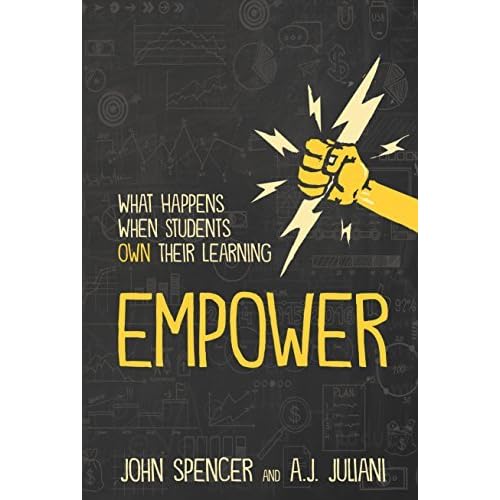

For 19 years I was that teacher.  The teacher whose students were being talked at and taking notes.  I would do so much work to find demonstrations to make the concepts come alive.  I spent countless hours writing and rewriting prescribed labs only to get back the same thing from every student.  The only thing I knew was "the old formula" for my students - to be compliant.  5 years ago I shifted to the flipped classroom and have seen increased engagement and empowerment in my students each year.

AJ & John define the empowered classroom as one that is (and I paraphrase here) committed to student interests, to prepare them for anything, to ask them "What do you want to learn?", to have students create their own path, having students assess their own learning, and to promote creativity.


In Chapter 3 they promote the shift from "making the subject interesting" to tapping into student interests.  As a physics teacher, I always prided myself on finding real-world examples to make the concepts relatable to my students.  I performed cool demonstrations (the disappearing eye dropper!), found interesting videos (Bill Nye anyone?), and created exciting activities (pushing my car to study Newton's 2nd Law!) to "wow" my students.  There was one thing I didn't realize then - these things were all cool and exciting to me, but were they cool and exciting to my students?  I was doing so much more work than my students were.  In a traditional classroom, it is easy to sit there and "do school"  - take notes, fill out the worksheet, complete the lab report, take the test, REPEAT.  However, empowering students takes more work on their part than a traditional classroom as students now take ownership of their learning.  Empower pushes me to ask my students what their interests are and how they can relate the concepts to these interests.


Student choice is the basis for Chapter 4 and has challenged me to rewrite my unit on Waves and Light next term.  I give students choice in my classroom from Genius Hour to their products that showcase their learning.  However, I have not gone full PBL and empowered my students.   I am currently planning for students to choose how they access the content for Waves and Light (characteristics, behaviors, the EM Spectrum, image formation by mirrors and lenses), then asking them to demonstrate their knowledge by making a video (or digital book or podcast) their classmates can also access to learn the concepts.  By doing this I hope to achieve AJ & John's goal of - "Changing the game of school means actually allowing students to create their own game.  This is empowerment."  This empowerment really starts with a single question as posed in Chapter 5, "What decisions am I making for my students that they could make for themselves?"   As each year of flipped learning has gone by, I have given up more and more control to the students.  "It's a shift from a compliant mindset to a self-directed mindset" as AJ & John stated in Chapter 6.  This shift is not only for teachers but for students as well.  


In Fall 2016, I introduced an Innovations Class to my high school.  I had been inspired by Don Wettrick and his students at Noblesville HS and wanted to offer this opportunity to my community of learners.  This type of class is one that demands students to be self-starters and self-managers (Chapter 6).  Students begin by choosing topics, writing pre-mortems, and proceed to chart their course.  They further set 2-week plans, choose strategies to achieve their goals, and provide evidence of answers to their questions.  During this process, there is much 1:1 peer assessing (via Walk and Talks) and self-assessing of their progress.   Some are conducting interviews, creating and analyzing surveys, reading articles, watching videos, and cold emailing professionals in the field.  Yes, and all this is going in one classroom!  It may appear chaotic from the outside, but I appreciate how each student is choosing to create his/her "authentic research experience."  (Chapter 7)


Now how does a teacher go about assessing these new experiences?  In Chapter 8 AJ & John challenge teachers to make assessment more like life and less like school.  "The shift from taking an assessment to assessing their own learning."  My classroom has become full of micro-conversations with individual students, thus giving consistent feedback throughout the learning process.   But how I can I empower students to own the assessment process?  They suggest students be able to figure out:
  • what they already know
  • what they don't know
  • what they want to master
  • what they will do to improve
"Through self-assessment students attribute success to themselves, not the teacher and feel empowered."  I look to use more of what they recommend to challenge my students to: 
  • chart progress
  • track goals
  • self-reflect
  • survey their learning
  • self-assess with rubrics
  • use checklists
These are many ideas to consider when designing assessments to include students in the process.


In Chapter 10 AJ & John talk about ice cream.  Ice cream?  They lay out the argument of differentiation in a tiered system compared to an adjustable system.  Their example is as follows:  at Baskin Robbins you can choose your flavor and choose 1 scoop, 2 scoops, etc.  However, at your local frozen yogurt place, you can choose exactly the amount of fro-yo and the type and amount of toppings as well.  From the tiered system of BR31 where the teacher provides the options to the adjustable system of fro-yo where students "own the entire process."  Now before you open up your fro-yo classroom, think about this - what about a Coldstone Creamery classroom?  That is one where "students move from choice to freedom in the content."  They take it one step further and ask, "What if students felt the permission to modify things on their own?  #mindblown  For a student to modify on their own s/he would have to be in tune with their learning style.  I have sat in many IEP meetings where parents and teachers discuss the accommodations in the plan.  But instead of parents and teachers being responsible for these, what if the student took real ownership of their learning and designed their own strategies to best assess their learning?  There is much to consider here and would be a shift in thinking how to execute an education plan.  With classes of students with a multitude of learning styles, this appears messy and chaotic, but as AJ & John state, "but it doesn't matter, its frozen yogurt, every work is supposed to be different."


When I reflect on my first 19 years of teaching, I thoroughly enjoyed being up there in front of the students.  Every lecture was a performance.  I loved making bad physics jokes and being the one person in the room who had all the attention.  How could I flip my class and put my students in charge of their learning and be relegated to "guide on the side"?  What would happen to me?  AJ & John respond, "So does being a "guide on the side" mean you lose your influence?  No.  Guides are actually pretty influential (take Gandolf, Yoda, Ms. Frizzle)."  In my flipped classroom I feel even more important now that I have the time to talk to every student every day and be their guide.


Thank you AJ and John for reaffirming for my shift in teaching 5 years ago, the inspiration to keep going, and the new challenges you pose in Empower.

Monday, February 19, 2018

Encouraged by Shift This!

Last year one of my Edu-Heroines, Joy Kirr, shared her story of shifting from a traditional classroom to a student-centered learning environment.  Shift This provides teachers a window into her classroom and how she has changed the learning space, classwork, homework, & grading and further challenged her students to become self-directed.  Here are my takeaways from her book:


In Chapter 4 Joy shares with us the power of music in the classroom.  As I have been practicing flipped learning the past 5 years, I always look for ways to get music into my video lessons.  "Freefalling" by Tom Petty is pretty obvious for a video on gravity and thanks to Justin Timberlake for the song "Mirrors" as the intro to my video on image formation by mirrors.  I have been playing music during class for years now.  I even installed 4 speakers in each corner of the room to create some surround sound.  I take requests from students and even have my room playlist up on Spotify.   As much as Joy promotes music in the classroom,  she truly does practice what she preaches as she played and even sang along to "Let It Go" last summer during her presentation at BLC17!


When I was a traditional classroom teacher, I did my best to answer every one of my students' questions.  However, in my flipped learning environment, I often put their questions back on them.  Joy states, "If students ask you a question, ask it back to the class to see what they think.  Try your best to not answer their questions, let them figure out their own answers instead (Chapter 5 Classwork)."  This has been a big transition for me as I now usually answer a student's question with a question.  The most common instance of this is when my students ask me to check their answer to a physics problem.  Pre-flipped learning I simply answered it, but these days I encourage them to check with their group (they sit in groups of 4 students) or I ask them to describe to me how they solved the problem.  By doing this I aim to promote more collaborative problem-solving and learning the process over just getting the right answer.


What is the true purpose of grading?  Feedback.  My students work in small groups (usually 2) on projects to showcase their learning by creating digital books, screencasts, and slide presentations.    When one of the students asks me to check the work,  I typically respond with, "Can you have your partner proof over it first?" In Chapter 7 Grading Joy observes, "The more feedback students can give one another before you see their polished work, the better the work will be by the time it gets to you."  
This is definitely true as I witness the conversation that ensues and seeing them make improvements to their work before asking me again for feedback.  This gives me more confidence that both students are working collaboratively and that the product best represents their effort. 


I first heard of Joy Kirr when I began searching for more information on Genius Hour.  She is the curator of the spectacular Livebinders page on Genius Hour.  I have incorporated this passion time or 20% time into my flipped classroom the last 5 years.  Genius Hour provides students with the  class time to research a topic they are interested in.  As a process of this style of self-directed learning, I am always asking students to blog on the questions, "What did I learn?" "What are the next steps?" as Joy encourages.  In Chapter 9 Student-Direct Learning she states, "The biggest result of including Genius Hour in my pedagogy is that I am now comfortable enough to offer more student voice and choice in all we do."  Absolutely Joy!  I find myself allowing students to make more choices on how they present their learning.  In fact, a student last week asked me what example she should use in a presentation as evidence of learning a concept.  She even gave me a few choices for me to select from, but I simply responded, "Whichever example you think best illustrates the concept."  Her mind was blown!  


In conclusion, I would say the biggest takeaway from reading her book has been inspiring me to finally take my desk out of my classroom.  I did it!  Now that I am over halfway through the school year, I can honestly say it is the best thing I have ever done.  Joy asks in her book, "How do you build trust with students?"  Without being chained to a desk, it forces me to walk around more and talk to students.  It is these one-on-one conversations about their interests and connecting with them that improves the overall learning.  It is not sitting at my desk going through emails or blogging (haha!).


A BIG thank you to Joy for sharing her story!  As I have also shifted my classroom, it is comforting knowing there are more teachers out there like Joy taking these risks and reaping the benefits and rewards for their students.


Thursday, February 8, 2018

Micro-Conversations in My Flipped Classroom

5 years ago when I flipped my classroom, I was challenged with one thing - what was I going to do now that I wasn't in front of the classroom at the whiteboard?  I had to get out there now into the sea of students to help them, and seemingly without a life raft!

Not only was I not ready, but my students were not ready.  To foster an improved flipped learning environment I rearranged lab tables to promote more student collaboration and I also placed stools around the room for me to sit on as I interacted with students.  I remember the first day of school being at the front of the room going over the syllabus and then proceeding to sit down on a stool in front of a table of students.  One of the students backed up his chair away from me and I made the joke, "Am I too close?"  This was a shift as students were used to having the teacher far away in front of the room, while they sat back at their desks.  As awkward as this may have been for me and my students, some great things were about to happen . . .

Let me ask you a question - what are the biggest fears for a student in a traditional classroom?

Being called on to answer a teacher's question in front of his/her classmates and being wrong
Asking a "dumb" question in front of his/her classmates

In a flipped learning environment these fears are removed.  As I walk around and help students, they are more comfortable asking me questions one on one.  Flipped learning gives me this time to have these micro-conversations.  

If you walk into my classroom on any given day, you will see me talking to students, individually  or in small groups.  When a student has a question, I may sit down on a stool next to their table or sit with them if there is a spare chair.  Other times I may respond to a student's quetsion with a question and then tell them I will "do a lap" around the room to give them time to think deeper about my question and come back to them.

These micro-conversations involve:

responding to a student's question
asking a student a question to probe deeper thinking
asking a student to give more evidence of his/her learning
differentiating a problem or task for a student


So what is my life raft these days?  Chalk markers!  I use them to write on their lab table and give a "mini-lesson" to them.  These micro-conversations allow me to personalize learning and differentiate on the fly for each student.


I write on the lab tables more than I write on the classroom whiteboard.  The shift from lecturing all of my students to having micro-conversations with individual students has enabled me to better personalize learning.  It is definitely safe to say that  I talk to every student every day.  I know where each of my students is with their content knowledge/skills and can take them from where they are giving them the necessary feedback at the time they need it.

How do you create opportunities to get you know your students better?

What strategies do you use in your classroom to allow for more micro-conversations?

Please leave your comments below.  Thank you!